Sunday, November 13, 2011

Prague, It's What's for Dinner


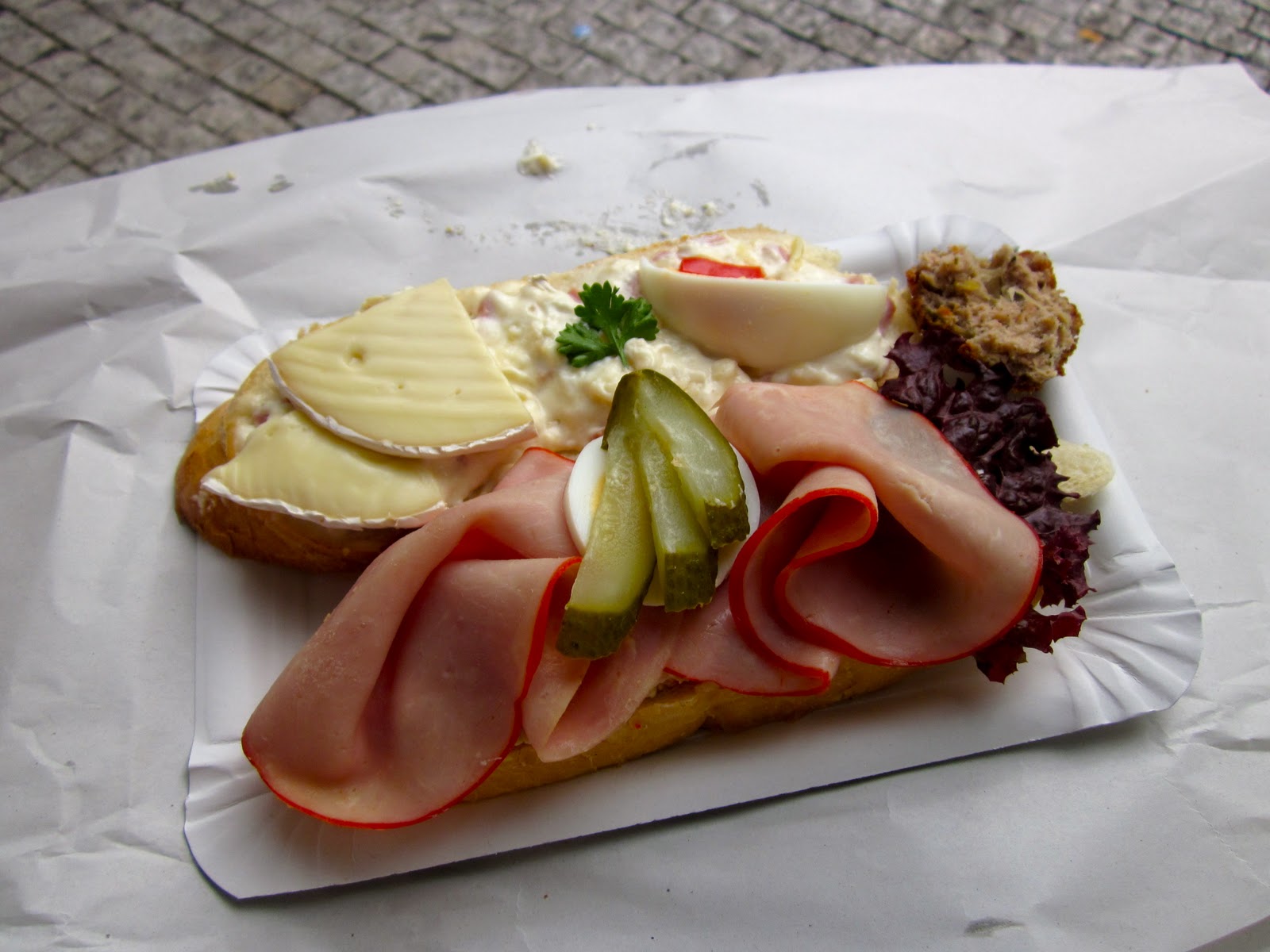
In Denmark, the typical formation of a sandwich is open-faced, with some sort of spread and meat on top of a dark, dry, dense rye bread.  It is called a smørrebrød, which literally translates to butter and bread.  In Prague, my friend and I went exploring and discovered these delicious sandwich-things, which resemble the typical Danish smørrebrød.  One had some brie spread + brie + more cheese (heaven help the lactose intolerant) and another had potato salad, turkey and pickle.  All together, lunch cost a grand total of ~ $1.80.  Believe people when they tell you Prague is CHEAP. 

A typical dinner in Copenhagen for one person costs somewhere between $50 and $150.  If you really want to go all out, the world's best restaurant, Noma, is conveniently located in Copenhagen and offers a lovely seven course meal for around $1000.  In Prague, however, a meal at a normal restaurant goes for $5-$10.  Taking full advantage of the fact that I could actually afford to go out to eat in Prague, I wasted no time seeking out some real, authentic Czech food.  

Enter goulash.  And bread dumplings.  And Becherovka.  Goulash is your basic roast meat in a thick brown gravy, complete with some onions and paprika.  Bread dumplings may be the heaviest white bread concoction ever, created specifically to soak up some of the gravy and expand in your stomach to epic proportions.  Becherovka... well, according to Wikipedia it's "flavored with anise seed, cinnamon, and approximately 32 other herbs."  According to Ashley, it tastes like licorice pumpkin pie shots and BURNS going down.  The people I went to dinner were casually sipping it (sipping!) like an after dinner coffee, whereas I pawned mine off on a girl conveniently celebrating her 21st birthday (No, here's to you, Carrie).


Unlike many other cities, the market place is alive and well in Prague.  All of the days we were in the city, the main square near the clock tower was transformed into a bustling market place, selling baked goods, meats and mulled wine.  While it was fun to walk around the square and see what was being offered, it definitely was marketing towards tourists and prices were hiked up.  


How cute is this little future pyromaniac?! 

One morning, the three of us took off on an off-the-map adventure, following the advice of some locals who told us about a "real" market.  Supposedly, this was a home-grown farmers' market that was a good place for an unconventional lunch or some souvenirs.  After walking for over an hour, past the Prague Castle and into a working class Czech neighborhood, we found a small park with a square in the center.  There, more than 30 tents had been set up by locals who were selling everything you could imagine: fresh fish, fresh meat, home brewed wines, spice mixes, vegetables, cheeses... the list goes on.  I had a field day.


For the record, 13 Czech Koruny is 70¢.  How was I going to say no to a poppyseed roll?  I am Czech, after all.  And it was flaky and homemade. Alright, force me.


Prague, Where Religion Rules

Well, officially the Czech Republic is a parliamentary republic, but in Prague, it feels as if churches are the kings of every street and square.  I am not certain that there are enough saints in the book to name every church in Prague… after all, several were actually named after Jesus.

The Church of the Infant Jesus of Prague

Another notable church is St. Vitus Cathedral, mentioned before as part of the Prague Castle compound.  The interior is at once gothic and beautiful. 


The Strahov Monastery, or Strahovský Klášter, is a large monastery perched at the top of a large hill overlooking the Castle and the city below.  Founded in 1140, the Church of the Assumption lies within the walls (as does a brewery, but that’s another story). 


Prague also has a good-sized Jewish Quarter that receives many visitors each year.  The Old-New Synagogue, or Staronová Synagoga, is the oldest preserved synagogue in Central Europe, dating back to the 13th century.


I was walking through the streets on Wednesday when I literally stumbled upon the crazy-bright Jerusalem Synagogue, or Jeruzalémská Synagoga.  Hidden along a side street, I do not even see it on the (overloaded) tourist map I picked up.  The outside is fascinatingly decorated, because many of the arches and striped designs are more reminiscent of Islamic décor.  The sign said that the synagogue had closed until next April – kind of a bummer, because given the exterior I can only imagine what the inside looks like.


Many of the churches and synagogues in Prague either charge a fee to walk inside or strictly forbid photography.  For that reason, I only have one contraband picture from the Infant Jesus of Prague, shown above… Should I have declared that in customs?   

Thursday, November 10, 2011

Prague the Pretty (Packed)

Interesting the difference 250 miles can make.  Berlin feels like a western European city, resembling London or New York in many ways.  English is routinely spoken, and foods like schnitzel and sausages are familiar.  Prague, however, is another place entirely.

One of my friends said that Prague felt like a fairytale land, and with backlit churches and brightly colored buildings with red roofs, I can see how she felt that way. 


Whereas many European cities have been overhauled, rebuilt and reorganized, Prague maintains the same street pattern it had in medieval times.  This means that whereas a map will say, “Oh yes, Kanovnicka goes straight for a good 0,3 kilometers,” in reality you have to twist and turn at least three times, choosing whether to go left or right to stay on the street.  Still, it is worth the confusion and searching to find some of Prague’s well-preserved sights. 

The astronomical tower, or Staromestská Orlojem, was created in the 15th century.  Between the hours of 9 a.m. and 9 p.m., the 12 apostles circle around the clock.  The tower has a combination of a calendar board containing zodiac signs and an analogue clock. 

The Prague Castle, or Pražský Hrad, was founded in the 9th century and has been developing continuously for the past 11 centuries.  There are several different parts to the compound, not the least of which are the large entrance gate and St. Vitus Cathedral. 


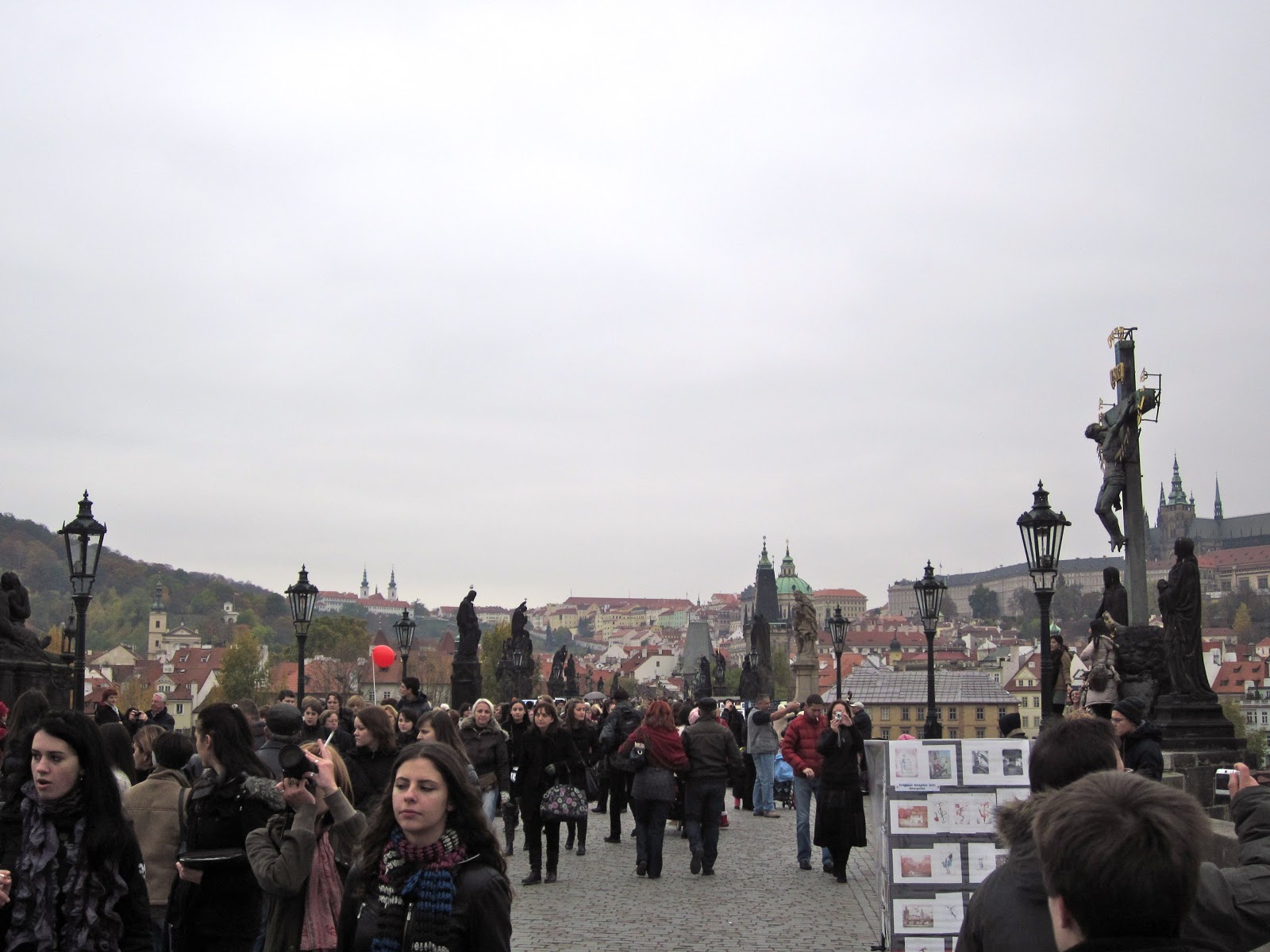
The Charles Bridge, or Karlův Most, was founded in 1357 by Charles IV.  There are two huge towers on each side, and more than 30 Baroque sculptures line the bridge.  Rumor has it that during the construction of the bridge, eggs held much of the mortar together… feel safe, millions of tourists who make the trek across the footbridge each year.

Charles Bridge with the Prague Castle in the distance


My only complaint about Prague was how many tourists there were in the city.  It was almost impossible to go anywhere without people speaking English and talking loudly.  Still, night or day, crowded or empty, the city is a sight to see.


Tuesday, November 8, 2011

Berlin, As a Foodie

I am a self-proclaimed foodie.  If you know me at all, you probably know that some of my favorite websites are food blogs.  I think about food awake or sleeping and I love to make food for family and friends.  Therefore, I have to write a post about the lovely cuisine that sustained me during the time in Berlin. Obviously.

Let's start with a German favorite, according to top 10 lists and Frommer's: currywurst.  You take a weiner (said it), heap curry powder on top, put some tasty ketchup/barbecue sauce on top, add some fries or potato salad on the side, and serve it up.  Yum, y'all.


Berlin also has a sizeable population of Turks, many of whom live in the Kreuzberg neighborhood.  I took a trip there to eat some Turkish food.  I split an order of hummus and kebabs with a friend, and drank an Efes beer and Turkish coffee.  The lamb kebabs were gone too quickly to picture, but the others were successfully captured.

My roommate, Tom, once heard that if you finish your coffee and flip the cup over onto a platter, you can read your future in the grounds.  We all downed the chalky, thick black espresso-mocha-coffee-drink that smelled like dirt, then proceeded to flip cup.  A couple of minutes went by before we checked for results... the sludge on the bottom of the cups was so thick it had not even moved.  I choose to interpret this to mean that my future is so solid, so undeniably successful, that nothing can change its course of success.

Dreams, people.


Lest we forget the good stuff...


Beer may be a mainstay of life in Europe, but the biergarten is a mainstay of life in Germany. While I did try my fair share of beers in order to get a proper and literal taste of the culture, a favorite is the tasty Weihenstephan.  Then again, it also could have been the atmosphere I drank this particular beer in.  Word the wise: if ever in Berlin, be sure and make it to Prater Garten, Berlin's oldest biergarten.  Though we had fabulous weather, it was too cold at night to sit outside, but the inside is hyggeligt (cross culture! Danish word for cozy/comfy) and I'm sure it is wonderful in the summer.

Berlin: fattens you up, but God it's good.

Monday, November 7, 2011

Berlin, With a Past

One cannot deny that even after apologies have been made and forgiveness granted, the past still remains.  History cannot be erased by reparations or pardons, just as red wine will always leave some form of stain on carpet (not buying it, Oxy Clean [R.I.P. Billy Mays]).  Berlin is a city with historical baggage.

From the TV tower that still looms to the stark difference between Unter den Linden and Karl Marx Allee -  the capitalist and communist boulevards, West and East Berlin, respectively - there is an undeniable history entrenched in the blood of Berlin.  As mentioned before, my hostel is located near the East Side Gallery, in the (now) trendy Fredrichshain neighborhood of the East.  When the wall was still up, this was a city for the working class, those kept on the poorer, less prosperous side of the city.  Hulking concrete masses of buildings line streets, silent reminders of a past when Trabants were the car of choice on these roads.   Today, however, the Fredrichshain neighborhood is one of the liveliest in Berlin, popular with hipsters and professionals alike.  A change has been made.

During World War II, Allies and Axis powers bombed each other, each doing their best to weaken a hulking enemy.  Just as I noticed the way London was largely rebuilt in some areas during my visit in early October, Berlin bears some scars and alterations, as well. A change has been made.

Bullet holes in the columns of one of the museums on Museum Island
The Memorial to the Victims of War and Torture
Less than 70 years ago, Jews and "misfits" from all over Europe were killed by German soldiers.  These men and women may have been from Romania or Poland, or they may have been from Berlin.  If they were from Berlin, there is a chance they could have used the Eberswalder Straße train station.  Then, it would have been a hostile place, somewhere that Jewish symbology and a Germany under Hitler could not have coexisted.  Today, such is not the case.


A change has been made.

Sunday, November 6, 2011

Berlin the Beautiful

Fall break started last Friday for me.  As of 13:00, I started my break from the strenuous, grueling hours of study and toil I have undertaking since going to Copenhagen... yeah, "As if!"

Before leaving Copenhagen, I hung around for Sensation CPH on Saturday night.  The lineup was something like three people I don't care about, Juan Sanchez and Daniel Sanchez, Martin Solveig, and Hardwell.  I think everyone I know expected Hardwell to be best, but Martin Solveig may or may not have stolen the show.  He somehow managed to play over an hour and a half of amazing stuff; he alone was worth the €80 price tag.  I also bumped into three girls from W&L that I didn't realize were going to be at Sensation -- small world, for sure.

Monday I left for BERLIN with my three of my roomies.  We packed so many different things into the three full days that we were in the city that I legitimately don't know where to begin.

Our hostel was right next to the East Side Gallery, which is a stretch of the Berlin wall that has been left up and decorated by many artists from around the world.  The famous picture of Communists Honecker and Brezhnev kissing each other is there, as are several other colorful and meaningful pieces.  Some of my favorites:


We also saw several of the "typical" Berlin sights - the Reichstag (home of German Parliament), Checkpoint Charlie, the Brandenburg Gate (a sort of Berlin Eiffel Tower), Museum Island, and the Berlin Cathedral.

The Reichstag
Brandenburg Gate
Berliner Dom
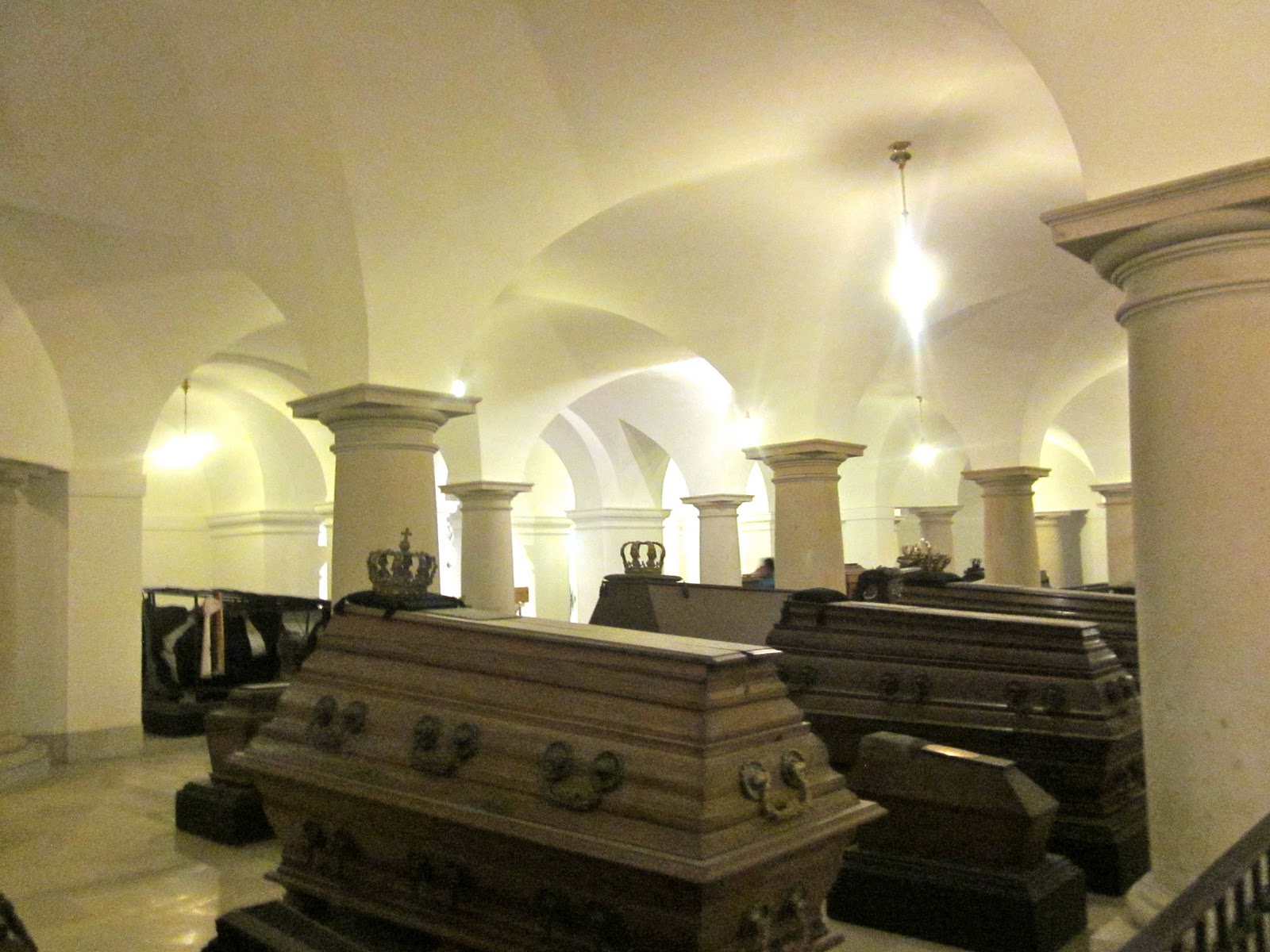
Probably the biggest sightseeing surprise of the trip was the Berlin Cathedral, or Berliner Dom.  Originally, I planned on doing the normal church tour: ooh and ah over the nice altar decorations, look at statues of MML&J, move along.  This cathedral, however, is completely out of the norm: there are two levels to overlook the main worship area, and the crypts below are open.  The coffins of the royal German Hohenzollern family from the 12th-17th centuries are openly displayed there.  The best part, though, comes you when climb.  And climb.  The interior of the dome of the cathedral has a walkway with windows looking out over the roof and Berlin, which is very cool.  Better, though, is when you continue to climb up narrow staircases and eventually hit fresh air.  There is an exterior walkway open which my roommate Tom and I climbed up to... so worth the trip.


Before I left for my trip, I told several Danish friends about my travel plans.  Each one, without fail, gasped and smiled when I mentioned Berlin - the American equivalent might be stripping naked and running around the neighborhood beating your chest and screaming in joy (more or less).  After being in Berlin for just three days, I now know why they loved it.  The city is beautiful and modern, simultaneously recognizing the past and developing the future.

Saturday, November 5, 2011

Let's Play a Game...

Can you guess where I've been in the past week?


Answers to follow!